Case 03
I Did Not Die Here
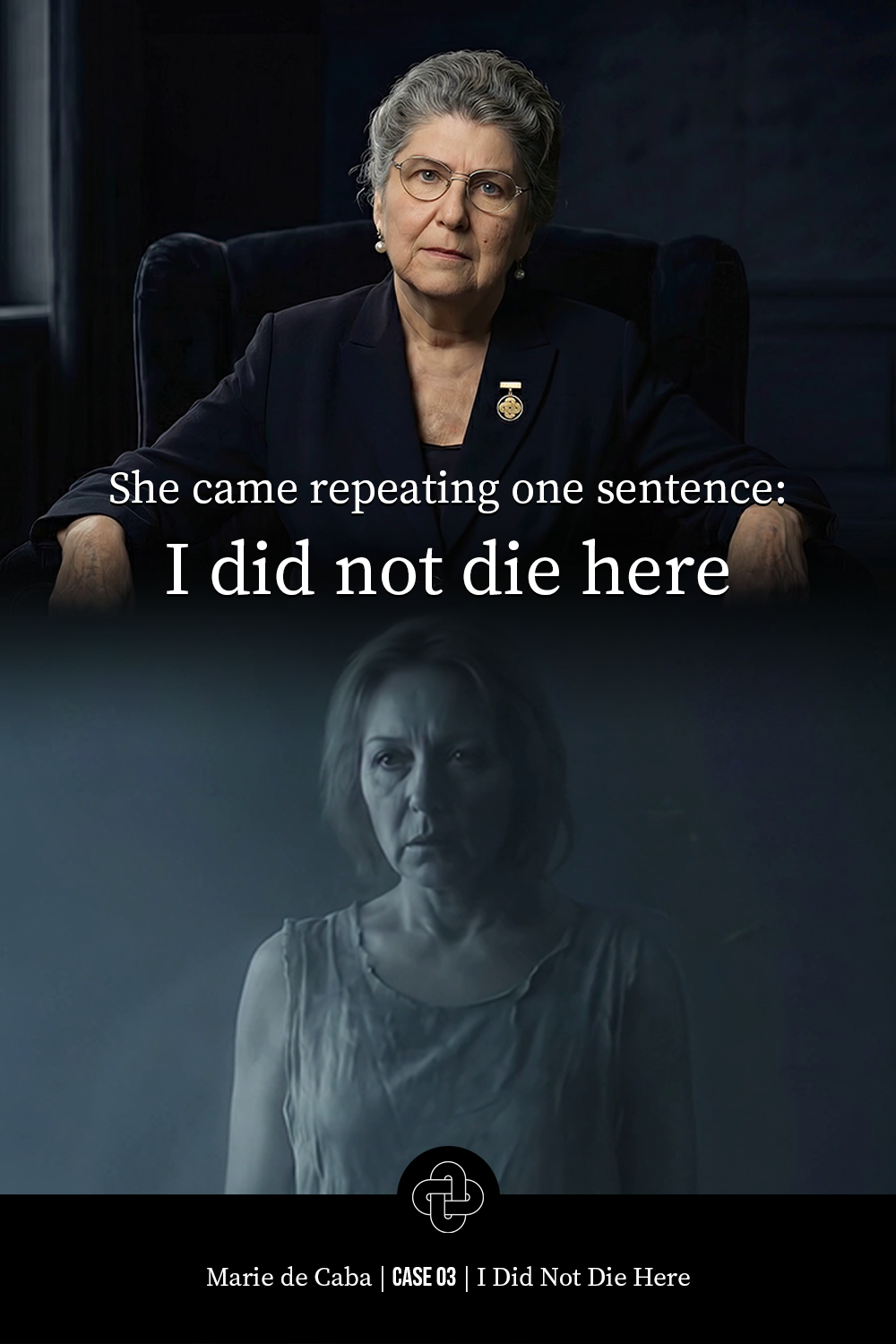
She came to Marie with one sentence.
“I did not die here.”
At first, the words sounded like a clue to a body, a grave, or a hidden death. But Marie soon understood that the spirit was not pointing to where she had died. She was pointing to where another silence was still alive.
Some spirits do not return to tell us where they are buried. They return to reveal who was never allowed to be found.
The Spiritist Doctrine Behind This Case
According to Allan Kardec’s Spiritist doctrine, the phenomena described in I Did Not Die Here can be understood through several principles: mediumship, spiritual perception, repentance, reparation, and the intervention of spirits in the moral life of the living.
Explore the Spiritist principles behind Marie’s cases.
This case is not only about a spirit repeating one mysterious sentence.
It is about a soul burdened by guilt, a hidden crime, and the possibility that the dead may return not to accuse, but to repair.
The spirit does not come back to speak about her own death. She comes back because someone living still needs to be found.
1. Mediumship and Spiritual Perception
Marie acts as an intermediary between the visible and invisible worlds.
The phrase that begins the case, “I did not die here,” suggests a form of spirit communication in which the medium receives a precise thought transmitted by a discarnate spirit. In Spiritist terms, this can be understood as a form of sensitive or auditory mediumship: the capacity to perceive a message, an intention, or a sentence impressed upon the mind.
But the case also suggests another faculty. Marie is not only hearing. She is being led.
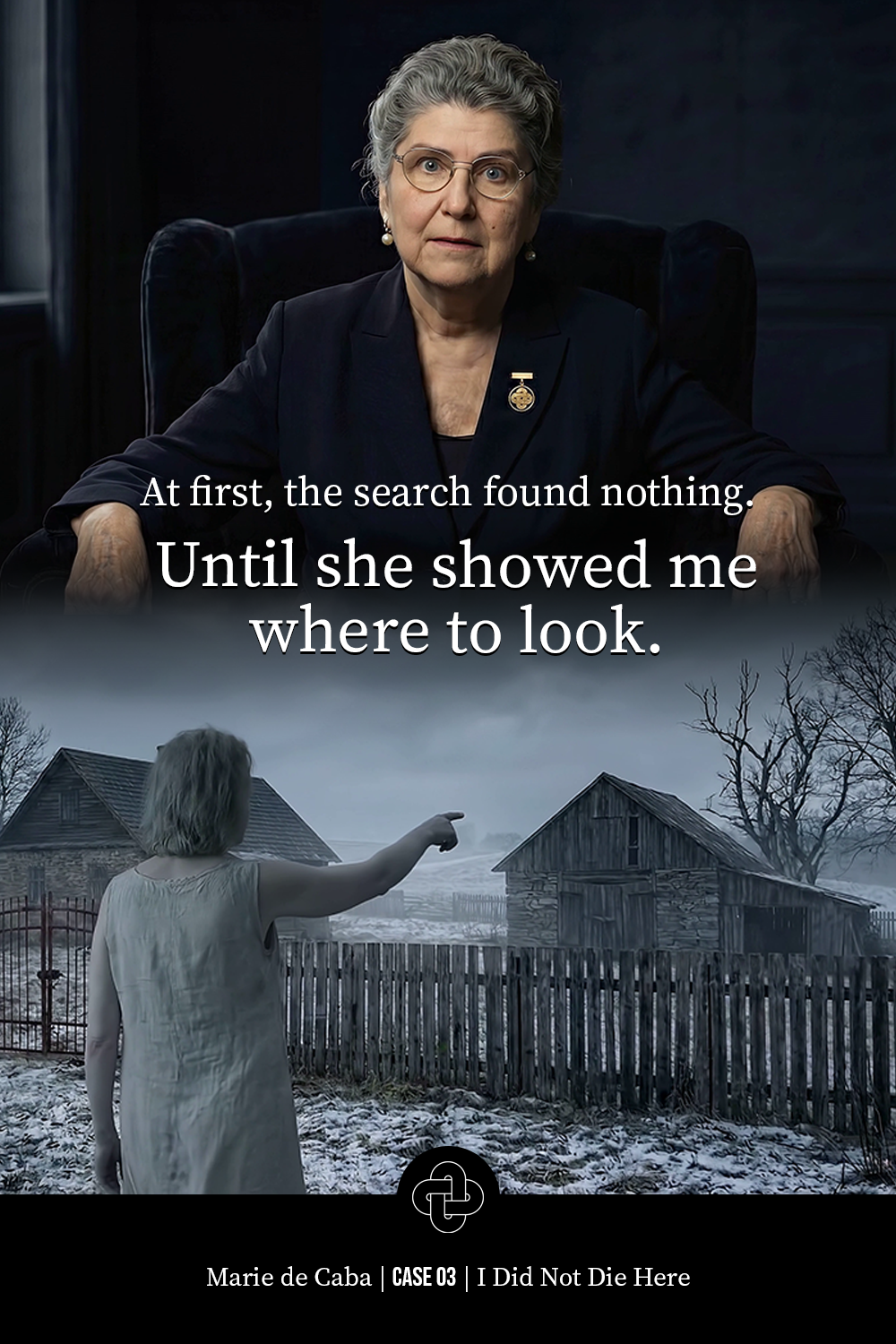
The movement toward the barn, the insistence on a specific place, and the sense that the spirit is directing her attention all point toward a form of spiritual perception. The spirit does not merely give information. She projects a path.
In this sense, the medium becomes more than a listener. She becomes the point where a hidden truth can enter the material world.
2. Repentance and Reparation
The spirit who comes to Marie is not innocent. She was connected to the man who kept the girl hidden. Whether through complicity, silence, fear, or moral weakness, she remained tied to the harm that had been done.
In Spiritist doctrine, death does not erase responsibility. Once freed from the body, the spirit may see its own actions with a clarity that was avoided during life. This clear vision can produce deep moral suffering.
That suffering is not punishment in a theatrical sense. It is conscience.
The spirit’s guilt is therefore not merely emotion. It is the beginning of repentance. And repentance, in Spiritist thought, is only the first stage. It must lead to reparation.
In this case, reparation becomes concrete: the spirit must help reveal the hidden girl. She cannot undo the past, but she can act so that the evil she witnessed or enabled no longer continues.
Her liberation depends on the liberation of another.
3. The Intervention of Spirits in the Material World
Spiritist doctrine allows for the idea that spirits may influence human events, especially through thought, intuition, coincidence, and moral impulse.
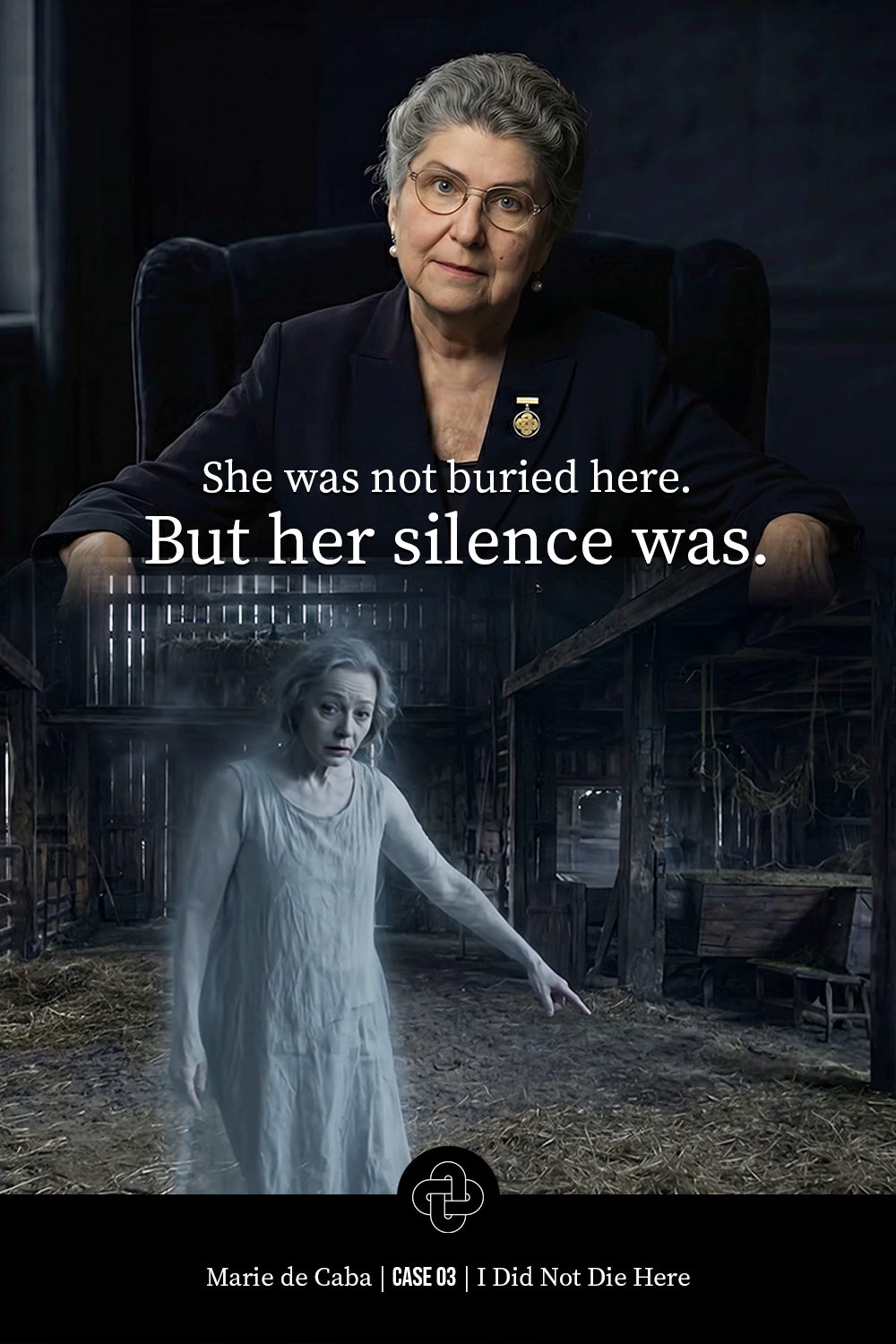
In I Did Not Die Here, the spirit’s intervention is not spectacular. She does not move objects or demand attention through terror. She insists on one sentence and one place.
Her action is directed. She gives Marie enough to follow the trail, but not so much that human responsibility disappears. The living must still listen, decide, search, and act.
This is important. In Spiritist terms, spiritual intervention does not replace human duty. It awakens it.
The appearance of the police, the discovery of the barn, and the rescue of the girl can be read as part of a chain of events in which the invisible world presses upon the visible one for a moral purpose.
The objective is not curiosity. The objective is justice.
4. The Meaning of “I Did Not Die Here”
The sentence “I did not die here” is doctrinally important because it is both true and incomplete. At first, it appears to be a statement about a corpse, a grave, or a place of death. But the spirit is not trying to identify where her body ended.
She is trying to separate herself from the lie attached to the place.
The sentence is an act of spiritual clarification.
She is saying: do not mistake my presence here for my death. I am here because of what remained hidden. I am here because the truth is still bound to this place.
In Spiritist terms, spirits may remain connected to places where strong moral events occurred, especially when guilt, violence, secrecy, or unfinished duty keeps the soul attached to earthly conditions.
The barn is not the place of her death. It is the place of her unresolved responsibility. That is why the message returns there.
5. Passage Toward the Light
Marie’s task is not only to understand the message. It is also to assist the suffering spirit.
In Spiritist practice, the medium may help a troubled spirit through reasoning, moral clarity, compassion, and prayer. The goal is not domination over the spirit, but assistance.
The spirit must understand her condition. She must recognize the truth. She must move from guilt toward reparation.
Only after the hidden girl is found does the spirit’s attachment begin to loosen. The chain that held her to the place was not the barn itself. It was the unfinished moral act.
Once the girl is rescued, the spirit has done what she returned to do.
The guilt does not vanish as if it never existed. But it changes. It becomes movement. It becomes progress. It becomes the beginning of peace.
Summary
I Did Not Die Here can be read as a case of mediumship, spiritual perception, repentance, reparation, and moral intervention from the invisible world.
The spirit returns with a sentence that seems to point to her own death. But the truth is deeper.
She is not asking Marie to find a body. She is asking her to uncover a silence.
Through the lens of Allan Kardec’s Spiritism, the case shows that the dead may remain linked to the places where moral debts were left unresolved. But it also shows that guilt is not the end of the soul’s journey.
When guilt becomes repentance, and repentance becomes reparation, the spirit begins to rise.
The dead do not always return because they are lost.
Sometimes they return because the living still need to be freed.