Case 04
One Loaf Never Sold
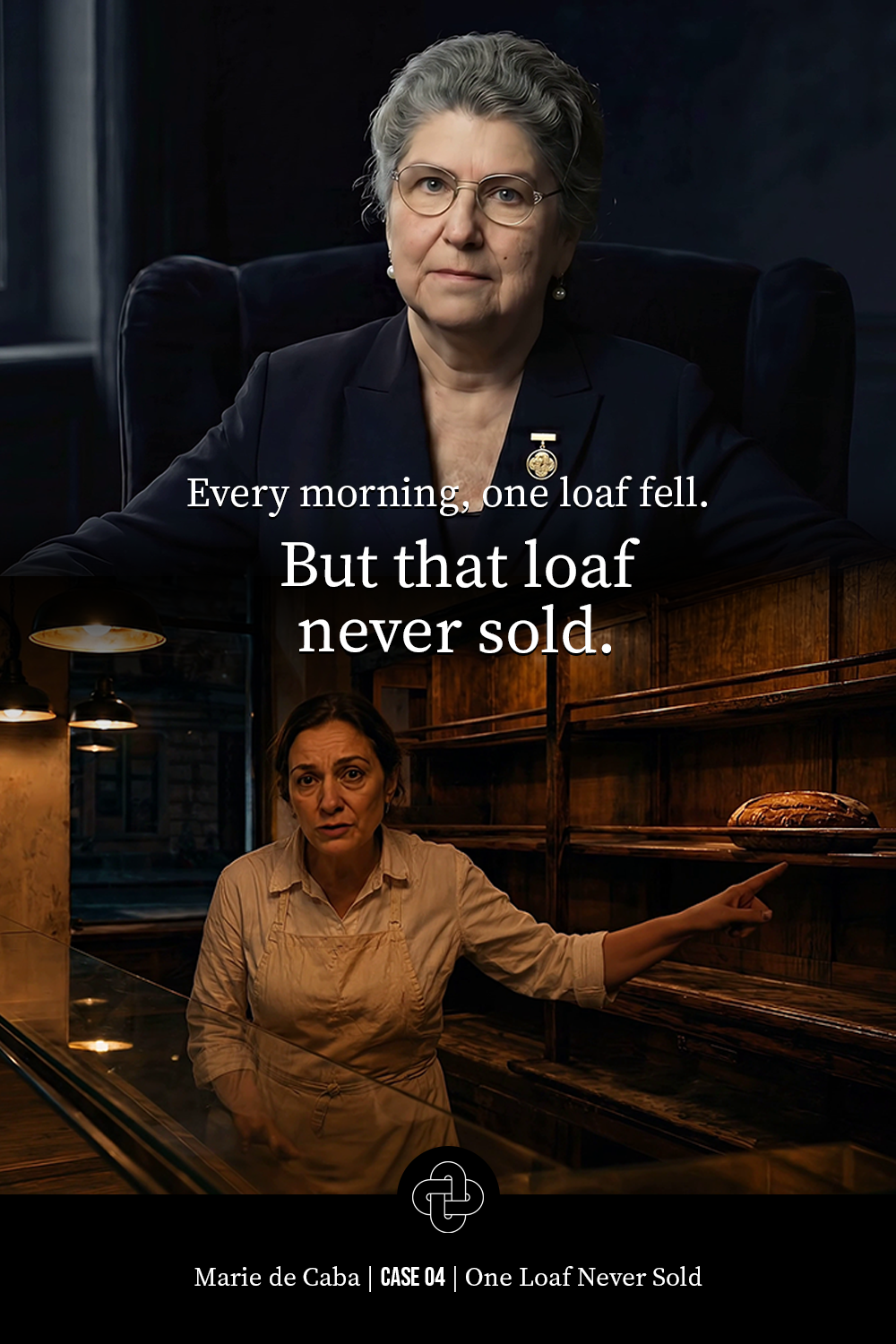
Every morning, one loaf fell from the shelf.
Not the others.
Only one.
The baker thought it was a trick, a defect, or a sign of something hidden in the walls. But Marie understood that the fallen bread was not meant to frighten anyone.
It was an errand. A spirit was still returning to the bakery, repeating a duty from a life that had already ended.
He did not know that the street had continued without him.
The Spiritist Doctrine Behind This Case
According to Allan Kardec’s Spiritist doctrine, the phenomena described in One Loaf Never Sold can be understood through several principles: post-mortem confusion, attachment to earthly habits, spontaneous physical manifestations, and the moral assistance offered to suffering spirits.
Explore the Spiritist principles behind Marie’s cases.
This case is not about a haunting in the usual sense. It is about a spirit who did not yet understand that he had died.
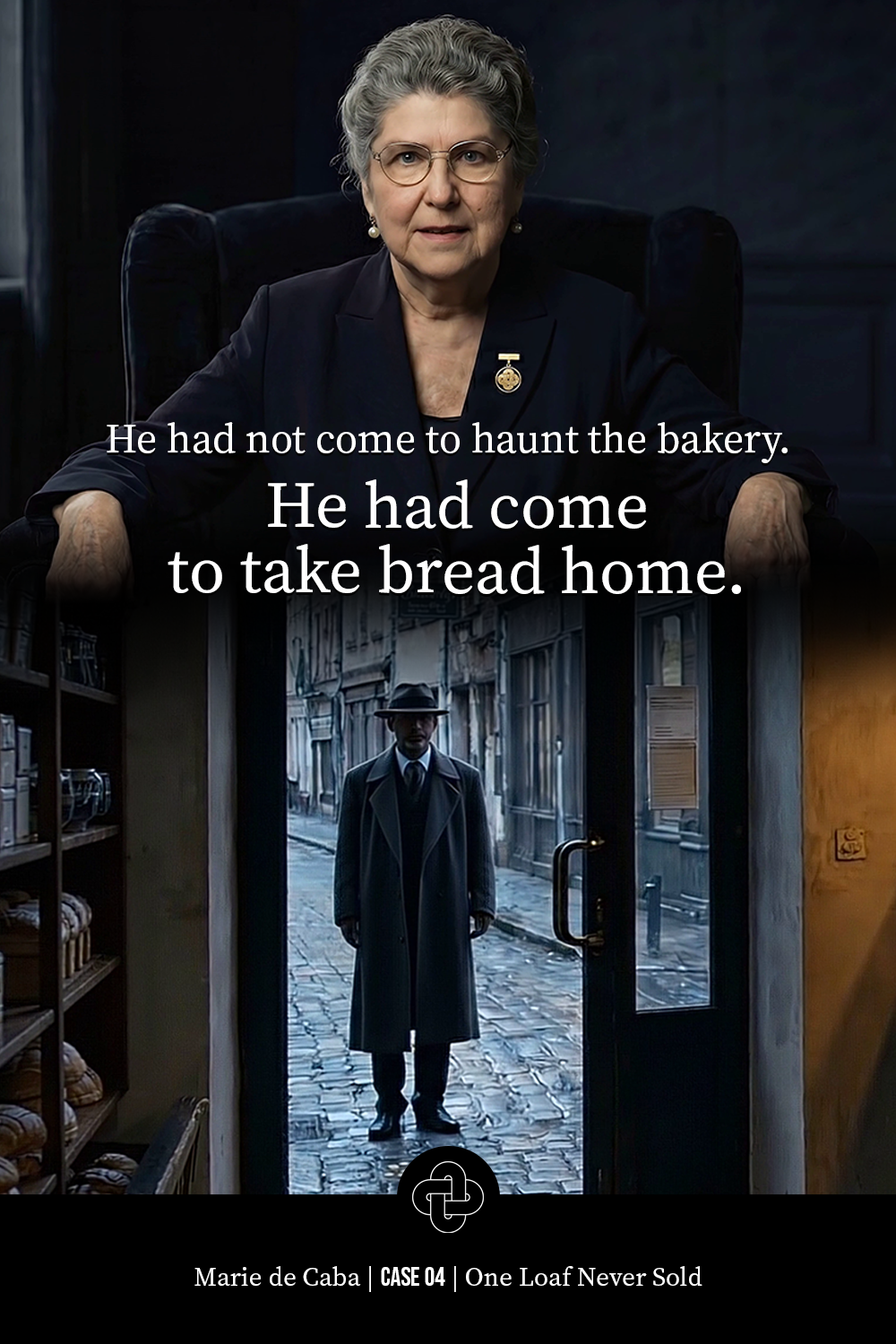
The loaf of bread falls because the spirit is still trying to complete an ordinary act from his former life. He is not trying to terrify the living. He is trying to continue.
He comes back because, for him, the morning has not ended.
1. Spirit Confusion and Ignorance of Death
In The Spirits’ Book, Allan Kardec describes the state of confusion that may follow death. The soul does not always understand immediately that it has left the body. This state, often called spirit confusion, may last only a short time, or it may continue for years.
In spirits still strongly attached to earthly life, this confusion can be especially persistent. They continue to feel, see, hear, desire, and remember. Because of this, some do not believe they are dead.
The spirit in One Loaf Never Sold is in this condition. He does not understand that his earthly routine has ended. He still believes there is an errand to complete, a wife waiting, and a loaf of bread to bring home.
The tragedy of the case lies in this simple misunderstanding. He is not trapped by hatred. He is trapped by habit.
2. Habit, Duty, and Attachment to Matter
Spiritist doctrine teaches that spirits may retain the affections, inclinations, desires, and habits they carried during earthly life, especially when they are not yet fully detached from material concerns. In this case, the spirit returns to the bakery not because the place itself has power over him, but because his last earthly duty still governs his thought.
He had gone for bread. And so he continues to go for bread.
The repetition of the fallen loaf reveals the persistence of an ordinary attachment. It is not a great crime, a curse, or a dramatic secret. It is something smaller and more human: the inability to understand that the world has moved on.
The street has continued. His wife has passed through many mornings. But the spirit remains fixed at the hour of his last errand.
3. Spontaneous Physical Manifestation
The falling loaf can be understood as a physical manifestation. In The Mediums’ Book, Kardec explains that spirits may act upon inert matter under certain conditions, especially when they can combine their own fluidic action with the vitalized fluids of people present, even when those people are unaware of any mediumistic aptitude.
This type of manifestation does not necessarily require conscious ritual, dramatic invocation, or a formal séance. Sometimes the phenomenon appears spontaneously. The spirit impresses its will upon the object. For a moment, the material thing becomes the visible sign of an invisible persistence.
In One Loaf Never Sold, the bread falls because the spirit’s intention is still attached to it. The loaf is not the message itself.
It is the trace of the spirit’s unfinished thought.
4. Moral Assistance to Suffering Spirits
Marie’s role is not to expel the spirit, but to help him understand. Spiritist practice gives great importance to the moral assistance of troubled spirits. The medium does not defeat the spirit through force. She speaks, reasons, consoles, and helps the spirit recognize its true condition.
This is why Marie does not treat the fallen loaf as a threat. She understands it as a symptom of confusion. The spirit must be helped gently. He must be told that his wife has passed through many mornings. He must understand that the bread is no longer needed. He must recognize that the duty holding him to the bakery has already ended.
In Spiritist doctrine, this kind of moral clarification is often more effective than fear, condemnation, or ritual exorcism.
The spirit is freed not because he is driven away. He is freed because he finally understands.
5. Release from the Place
Once the spirit understands his condition, the link that binds him to the bakery begins to weaken.
The place itself was not the prison. The misunderstanding was. The fallen loaf had been the visible sign of an invisible attachment: a habit, a duty, a morning that had never finished in the spirit’s mind.
When Marie speaks to him with compassion, she helps him move beyond the illusion that he is still living the same earthly day.
The spirit no longer needs to return to the shelf. The errand is over. The bread can rest.
And so can he.
Summary
One Loaf Never Sold can be read as a case of post-mortem confusion, earthly attachment, spontaneous physical manifestation, and moral assistance to a suffering spirit.
Through the lens of Allan Kardec’s Spiritism, the case shows that not all spirits return because they are malicious, vengeful, or trapped by darkness. Some return because they do not yet know they have left.
Some continue their ordinary duties because they still believe the living are waiting for them.
The fallen bread is not a threat. It is a message from a soul still caught in the habits of life.
Marie’s task is not to condemn the spirit, but to help him understand that the morning has passed, the duty has ended, and the road ahead is no longer the same street.
Some souls do not haunt the living. They keep returning to a life that has already ended.